
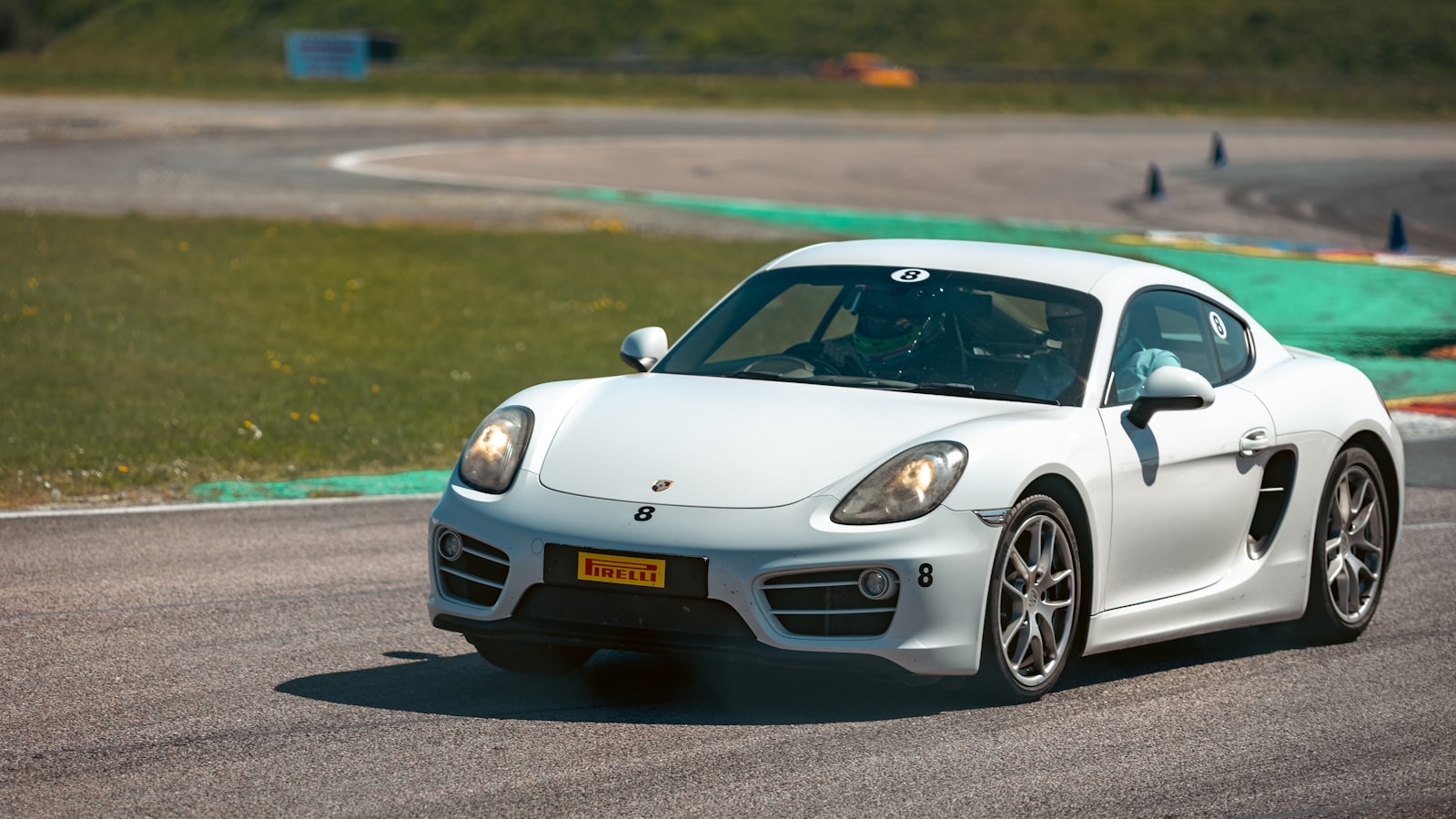
If you are reading this you are probably either thinking about a 718 Cayman GT4 RS, you own one, or you have driven one and want validation for the way it shocked you the first time you took it past 7,500 rpm. All three are reasonable places to be. I have instructed eleven different GT4 RS students at Buttonwillow this season alone, plus three at Thunderhill, and I'd like to write down what I think the car actually is — separate from what the press did with it in 2022, and separate from what owners often assume about how to drive it well.
What it is, mechanically
The 4.0L flat-six in the GT4 RS is, internally, the same MA1 engine you get in a 992 GT3. Same crank, same heads, same cam profiles, same redline. It is not detuned. It is not a different generation. It is fundamentally the GT3's motor packaged into a smaller, lighter chassis. The PDK in the GT4 RS is also the same gearbox as the 992 GT3's — slightly different ratios, slightly different software calibration, fundamentally the same hardware. The chassis is the 718 Cayman platform with the GT4 suspension geometry, wider track, more aggressive aero, and the now-famous airbox intake routing that delivers intake noise directly into the cabin via openings behind the driver's head.
The driving experience is the consequence of putting a 9,000-rpm naturally aspirated flat-six into a smaller car with shorter gears and a shorter wheelbase than the 911 it shares the engine with. The result is a track tool that is significantly more agile, somewhat more demanding, and faster around a tight road course than the GT3 it borrows from. At Buttonwillow CW13, a competent club-level driver in a GT4 RS will run a 1:54.5 lap. The same driver in a 992 GT3 will run a 1:55.2. The gap is bigger at tighter circuits and smaller at faster ones. Sonoma Raceway is the only circuit I know where I have consistently seen GT3s match or beat GT4 RS times in my students' hands.
What owners get wrong
Three things, in roughly the order of frequency I correct them.
One: not using the rev range. The MA1 makes peak power at 8,400 rpm. It will rev to 9,000. Most of my GT4 RS students short-shift at 7,000. This is a habit transferred from turbocharged cars, where there's no reason to take it past peak torque. The GT4 RS makes useful power above 7,500 rpm that you simply do not have access to if you upshift at 7,000. You will leave one second per lap on the table at any track over a minute long. The car was engineered to be used above 8,000 rpm. It rewards it.
Two: getting the brake bias wrong on iron rotors. The PCCB-equipped cars have factory brake bias that is roughly neutral for trail braking. The iron-rotor cars have slightly more front bias — fine on the street, but you'll get rotational instability under aggressive trail braking on track. The fix is either to run a PFC pad with a more aggressive front-to-rear friction split, or to run a rear pad with slightly higher mu than the front. I prefer the former because the latter requires fresh pads to maintain bias balance as they wear. The factory pads are fine for one HPDE day if you don't get carried away. After that, change them.
Three: tire pressure. The factory cold pressure recommendation is 32 front / 34 rear. On track with the Cup 2 R tire (the optional sticky tire), hot pressures of 36 to 38 all around are about right. I see students running cold pressures on track all the time. The car understeers, they think the chassis is the problem, and they leave. The chassis is not the problem. Their tires are at 39 PSI hot and the contact patch is wrong. Bleed pressure when the tires come up to temp and the car becomes a different car.
The daily-driver question
The marketing for this car, and the press from 2022, leaned hard on the "every-day capable" angle. That marketing is, I think, generous.
The GT4 RS will commute. Mine has air conditioning, a stereo, automatic climate control, a backup camera, and PDK that you can leave in Drive in traffic. The seats are bolstered but not punitive (the optional carbon buckets are punitive — they are also significantly less comfortable than the 18-way Adaptive Sports Seats, which are the better daily-driver option).
But the car is loud. The intake noise behind your head at 4,000 rpm in second gear is not optional. It is not adjustable. It is a feature of the car, and it is fatiguing on a forty-minute commute. The cargo space is one carry-on bag's worth in the front trunk and very little in the rear. The chassis is firm enough that broken Bay Area pavement is felt through the seat. The driveway clearance on the front splitter is a real consideration. I have a friend who scraped his at the entrance to the Whole Foods on Stevens Creek and the repair cost $4,800.
If your "daily" is a 35-minute commute on smooth roads with a parking garage at one end, the GT4 RS works. If it is variable terrain, a chip-sealed onramp, and parallel parking on Polk Street, you will hate it within six weeks.
What it's actually for
The GT4 RS is the track car you can drive to the track. That phrasing matters. The cars in this class that came before it — the 991.2 GT3 RS, the McLaren 600LT, the AMG GT R — were either too tall in their gearing to deploy on road courses below a certain size, or had ergonomics that punished anything other than committed track use. The GT4 RS occupies an unusual seam: aggressive enough to be a meaningful track tool at intermediate circuits, livable enough to drive ninety minutes to the track and back without it ruining your weekend.
What it is not is a great long-distance car. It is not a great commuter. It is not a great occasional-track car if you also want it to be a great Sunday driver in the Marin headlands.
It is — and I am being precise here — the most accurate distillation of the "road-going race car" idea that Porsche has built since the 996 GT3 in 2003. I owned a 996 GT3 from 2014 to 2019. The GT4 RS is, in spirit and in execution, what the 996 GT3 was at its release: a car that exists because its engineers wanted it to, not because the marketing team identified an opportunity.
If you can buy one and you can put track miles on it, this is the most rewarding modern Porsche I have driven. If you can't put track miles on it, you are not buying it for the reason it was built. There are better cars at this price for road-only use.
One footnote on the manual question
The 992 GT3 is offered with a manual. The GT4 RS is PDK only. I have been asked twenty times whether this is a problem. It is not. The PDK in the GT4 RS shifts faster than I can. It shifts faster than you can. At 8,500 rpm the time between deciding to shift and actually shifting is meaningful, and a stick will give it up. If you want to row gears, the Cayman GTS 4.0 is the better answer. The GT4 RS is a PDK car because it is a track car. Make peace with it or buy the GTS.